McMaster Institute · Culture · OD · HR · L&D
Why Supervisory Development Is the Most Overlooked Strategic Investment in Leadership
The Data That Should Trouble Every Decision-Maker
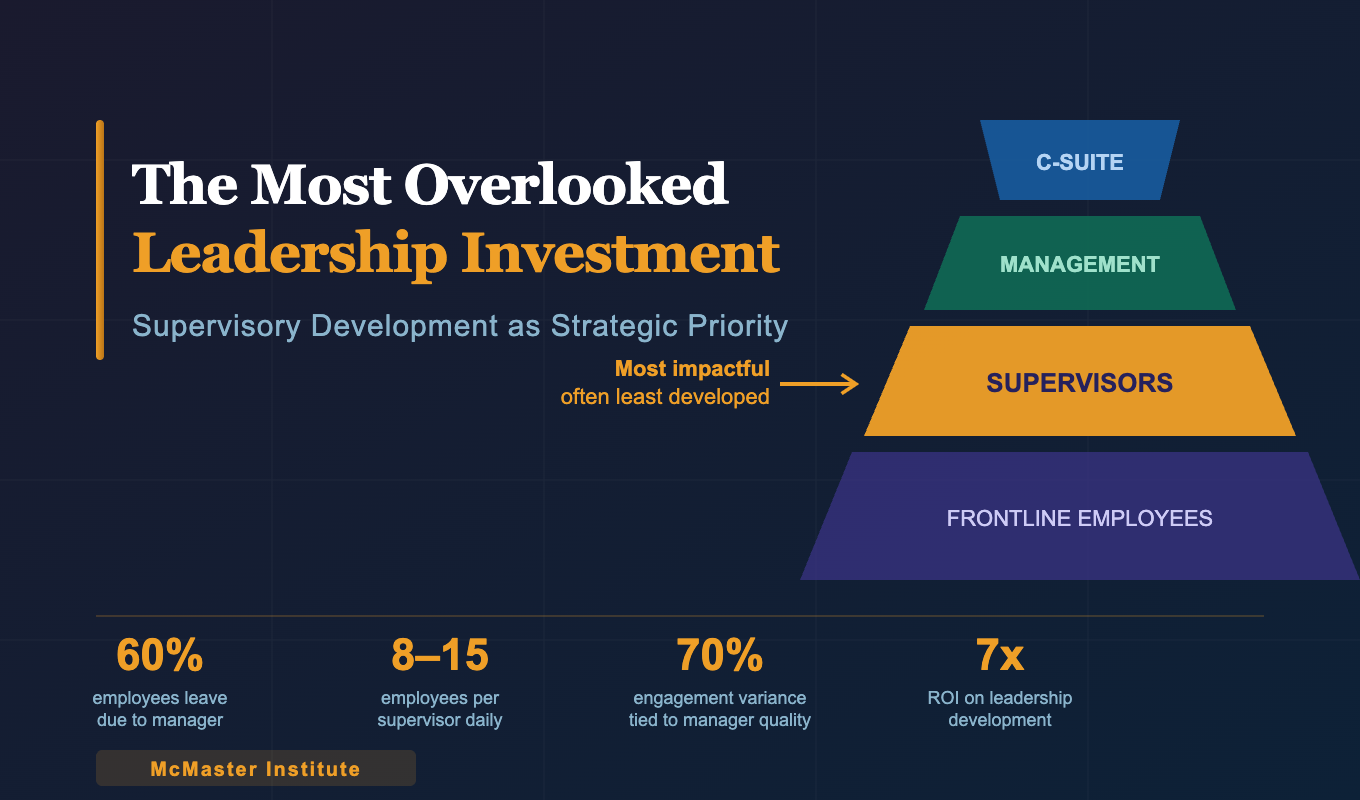
Almost 60% of first-time managers never received any management training — yet 70% of employee engagement variance is attributable to the manager. (Association for Talent Development, 2024)
57% of employees have left a job because of their manager. A further 32% have seriously considered leaving for the same reason. (DDI Frontline Leader Project)
Not their workload. Not their pay. Their supervisor.
Supervisors are not mid-tier managers. They are the first line of leadership — and they deserve to be recognised as one.
Where Strategy Becomes Behaviour
Senior leaders shape direction through policy and vision. Supervisors shape reality through daily interaction.
They are present for every correction, every performance conversation, every moment of escalation and ethical decision. They hear what employees actually feel. They sense what customers actually experience. They see risk before it becomes reportable.
Without realising it, management often overlooks that supervisors directly determine:
- Whether organisational values are lived or merely displayed
- Whether employees feel psychologically safe — or silenced
- Whether compliance is practised — or performed
- Whether performance standards hold — or quietly erode
Their tone sets the emotional climate. Their discipline sets the performance standard. Their integrity sets the ethical expectation.
The Transition No One Prepares Them For
Most supervisors are promoted for technical excellence. They were reliable. They delivered results. They were trusted.
But technical competence does not transfer automatically into leadership capability. The shift from individual contributor to supervisor is one of the most demanding professional transitions an employee will face — and most organisations offer little structured support for it.
This transition requires:
- Releasing the instinct to do — and developing the ability to lead
- Owning team outcomes, not just personal output
- Navigating difficult conversations with confidence and fairness
- Making sound decisions under sustained pressure
- Regulating emotion in moments that demand both calm and courage
Without development, many supervisors default to avoidance, inconsistency, or authority-based leadership. This is not a failure of character. It is a gap in preparation — and it is entirely addressable.
Culture Is Not Built in the Boardroom
Organisational values are not embedded through strategy documents or induction programmes. They are embedded through repeated behaviour — in real moments, at the frontline, by the person closest to the work.
Supervisors determine what is tolerated, what is rewarded, what is corrected, and what is escalated.
In regulated environments — banking, healthcare, financial services — this is not merely a culture concern. It is a compliance and reputational risk. Inconsistency at supervisory level creates vulnerability at organisational level.
84% of workers say poorly trained managers create unnecessary work and stress. (SHRM, 2020)
Culture is not lost at the executive level. It is lost at the frontline — quietly, daily, one supervisory interaction at a time. When supervisors lead by example — demonstrating fairness, accountability, and professional discipline — values move from written statements to lived standards.
Supervisors as the Organisation’s First Risk Line
Supervisors see early warning signs before they become reportable incidents:
- Conduct concerns before they escalate
- Performance decline before it becomes a crisis
- Customer dissatisfaction before it becomes attrition
- Policy deviation before it becomes audit exposure
The ability to identify, think critically, escalate appropriately, and respond with sound judgement is not innate. It is a developed capability — and it requires investment.
Gallup’s State of the Global Workplace 2025 report found that global employee engagement fell to 21% in 2024 — the steepest decline driven by a drop in manager engagement — at an estimated cost of $438 billion in lost productivity. (Gallup, 2025)
That single figure should reframe every conversation about where leadership development investment belongs.
Development That Creates Real Capability
Effective supervisory development is not a training event. It is a structured capability-building intervention that includes:
- Practical, workplace-applied learning
- Reflection and sense-making
- Coaching support and accountability structures
- Line-manager reinforcement and clear performance expectations
Gallup’s research shows that managers who complete coaching-focused programmes show 20–28% improvements in their own performance, with their teams experiencing up to 18% boosts in engagement. (Gallup, State of the Global Workplace, 2025)
When development is embedded in real work — not delivered in isolation — supervisors move from conceptual understanding to demonstrated capability. That is the difference between training that ticks a box and development that changes behaviour.
The Multiplier Effect
One strong supervisor influences 8 to 15 employees daily. Multiply that across every department, every shift, every team — and the strategic impact becomes undeniable.
Research by BetterManager and The Fossicker Group found that the average return on investment from leadership development programmes is $7 for every $1 spent — driven primarily by increased revenue, improved retention, and reduced recruitment costs. (BetterManager / The Fossicker Group, ROI of Leadership Development Study, 2023)
Investing at the supervisory level builds:
- Culture — values embedded through consistent behaviour
- Compliance — standards upheld through principled decision-making
- Engagement — employees who feel led, not just managed
- Performance — teams that deliver because they are developed
- Pipeline — future leaders who are genuinely ready
The Strategic Case
If an organisation wants sustainable culture, reduced risk, and a leadership pipeline that holds — the investment must begin at the supervisory level.
Not because senior leadership matters less. But because supervisors are the multipliers. They are where strategy either takes root — or fails to.
Gallup states plainly: addressing the manager development gap presents a “productivity boom opportunity” for organisations willing to act. (Gallup, State of the Global Workplace, 2025)
The gap is real. The evidence is clear. The question is whether your organisation treats supervisory development as a training line item — or as the strategic investment it actually is.